Advertisement










Private equity has played a significant role in shaping Indi...
In today’s real estate landscape, fitness is often treated...
In this episode of Prop Personalities, we sit down with Hars...
Luxury real estate is one of the most talked-about segments ...
Welcome to Prop Personalities by Prop News Time - a podcast ...
The Union Budget 2026-27 has drawn a positive response from real estate stakeholders, who see it as a long-term, infrastructure-led blueprint for urban growth. A sharp rise in capital expenditure, continued focus on Tier II and Tier III cities, and improved connectivity through high-speed rail corridors and City Economic Regions are expected to open new real estate growth corridors beyond metros. Industry leaders have also welcomed measures around REIT expansion, asset monetisation, financial sector reforms and simplified tax and compliance processes for NRIs and foreign investors, which are expected to improve liquidity, transparency and investor confidence across residential and commercial segments.
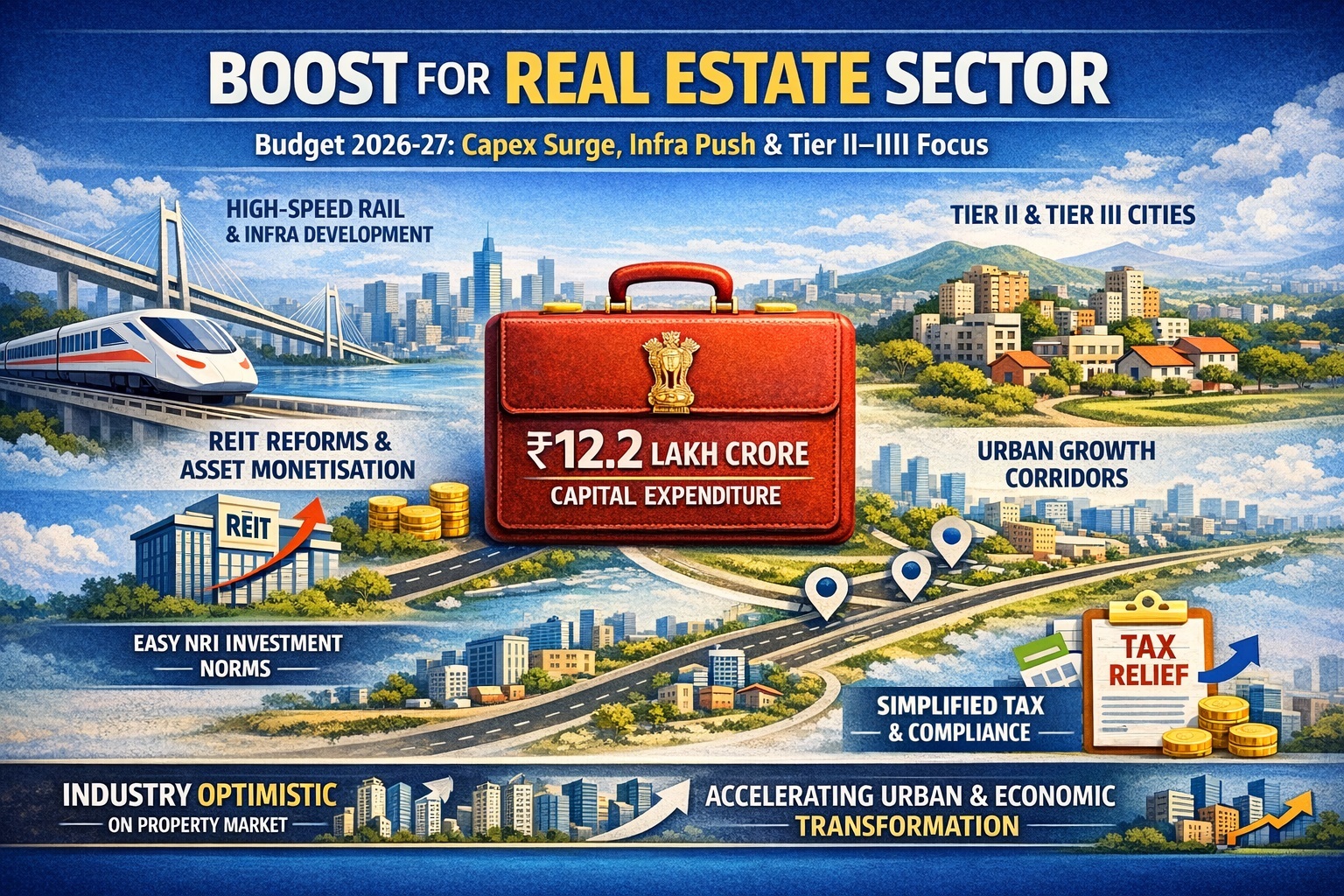
Industry leaders have broadly welcomed the Union Budget 2026-27, describing it as a decisive step towards infrastructure-led and regionally balanced urban development. The increased allocation towards capital expenditure, pegged at INR 12.2 lakh crore, is expected to stimulate demand across housing, commercial and mixed-use developments, particularly in emerging urban centres. Advertisement


According to Prashant Sharma, president of NAREDCO Maharashtra, the Budget reinforces the government's long-term commitment to inclusive and sustainable growth, with infrastructure development forming its core. He noted that the continued emphasis on Tier II and Tier III cities would act as a strong demand driver for real estate beyond traditional metros, as these locations are witnessing rising urbanisation, aspirational housing demand and growing commercial activity. For Maharashtra, he said improved connectivity, urban infrastructure funding and the focus on growth corridors would support housing demand and accelerate redevelopment across key cities.
Sharma also pointed out that the government's approach to fiscal consolidation, while sustaining infrastructure investment, would strengthen investor confidence. Measures such as REIT expansion, asset monetisation by central public sector enterprises and reforms aimed at improving ease of doing business were expected to attract long-term capital, while simplified tax processes for NRIs and a more investor-friendly foreign investment framework would further support the sector.
Kaushal Agarwal, chairman of The Guardians Real Estate Advisory, said the Budget sent a positive signal to both homebuyers and investors by reinforcing economic stability and long-term infrastructure planning. He observed that enhanced connectivity through high-speed rail corridors and city-centric growth planning would improve liveability and investment attractiveness in emerging urban markets, translating into stronger residential and commercial demand. Agarwal also highlighted that reforms to strengthen the corporate bond market, encourage REITs and streamline foreign investment norms would improve transparency and capital access for developers.
From a consumer and investor perspective, Agarwal noted that the creation of City Economic Regions and the focus on Tier II and III cities would unlock new housing opportunities offering better value beyond metros. He added that easing compliance for NRIs, including the removal of a separate TAN requirement for TDS on property sales and PAN-based challans for resident buyers, would reduce friction in cross-border property transactions.
Kamlesh Thakur, co-founder and managing director of Srishti Group, said the Budget reinforced the government's intent to build future-ready cities through sustained infrastructure spending and strategic urban planning. He added that reforms in NBFCs, improved banking health and better access to bond markets would support funding stability and timely project execution, while tax simplification and clarity for foreign investors would strengthen the sector's medium- to long-term outlook.
Several developers also highlighted the government's push towards asset monetisation through REITs. Shilpin Tater, managing director of Superb Realty, said the proposal to monetise under-utilised land and real estate assets of public entities through dedicated CPSE REITs marked a structural shift towards efficient asset management. He noted that, supported by recent regulatory changes such as SEBI's reclassification of REITs as equity instruments, the move could deepen India's REIT market, improve liquidity and reduce reliance on bank financing.
Industry participants further pointed out that incentives for digital infrastructure and data centres could create new opportunities for commercial real estate, while continued investment in transport corridors and City Economic Regions would improve last-mile connectivity and enhance the viability of residential and mixed-use developments in fast-growing locations.
Overall, developers and advisors agreed that Budget 2026-27 lays a strong foundation for long-term urban transformation, broad-based regional growth and a more transparent, investor-friendly real estate ecosystem.

5th Jun, 2025

25th May, 2023

11th May, 2023

27th Apr, 2023
Advertisement





 Facebook
 Whatsapp
