Advertisement










Private equity has played a significant role in shaping Indi...
In today’s real estate landscape, fitness is often treated...
In this episode of Prop Personalities, we sit down with Hars...
Luxury real estate is one of the most talked-about segments ...
Welcome to Prop Personalities by Prop News Time - a podcast ...
India's real estate sector ended 2025 with sustained momentum, supported by steady end-user demand, improving regulatory frameworks and large-scale infrastructure development. The year marked a clear transition towards consolidation, experience-led development and long-term value creation across asset classes. Residential demand remained resilient, redevelopment gained prominence in land-scarce markets and infrastructure emerged as a key determinant of urban growth. Industry leaders highlighted a growing emphasis on transparency, governance, design intelligence and sustainability. As the sector moves into 2026, growth is expected to be more structured and quality-driven, with connectivity, redevelopment, integrated planning and people-centric development shaping the next phase.
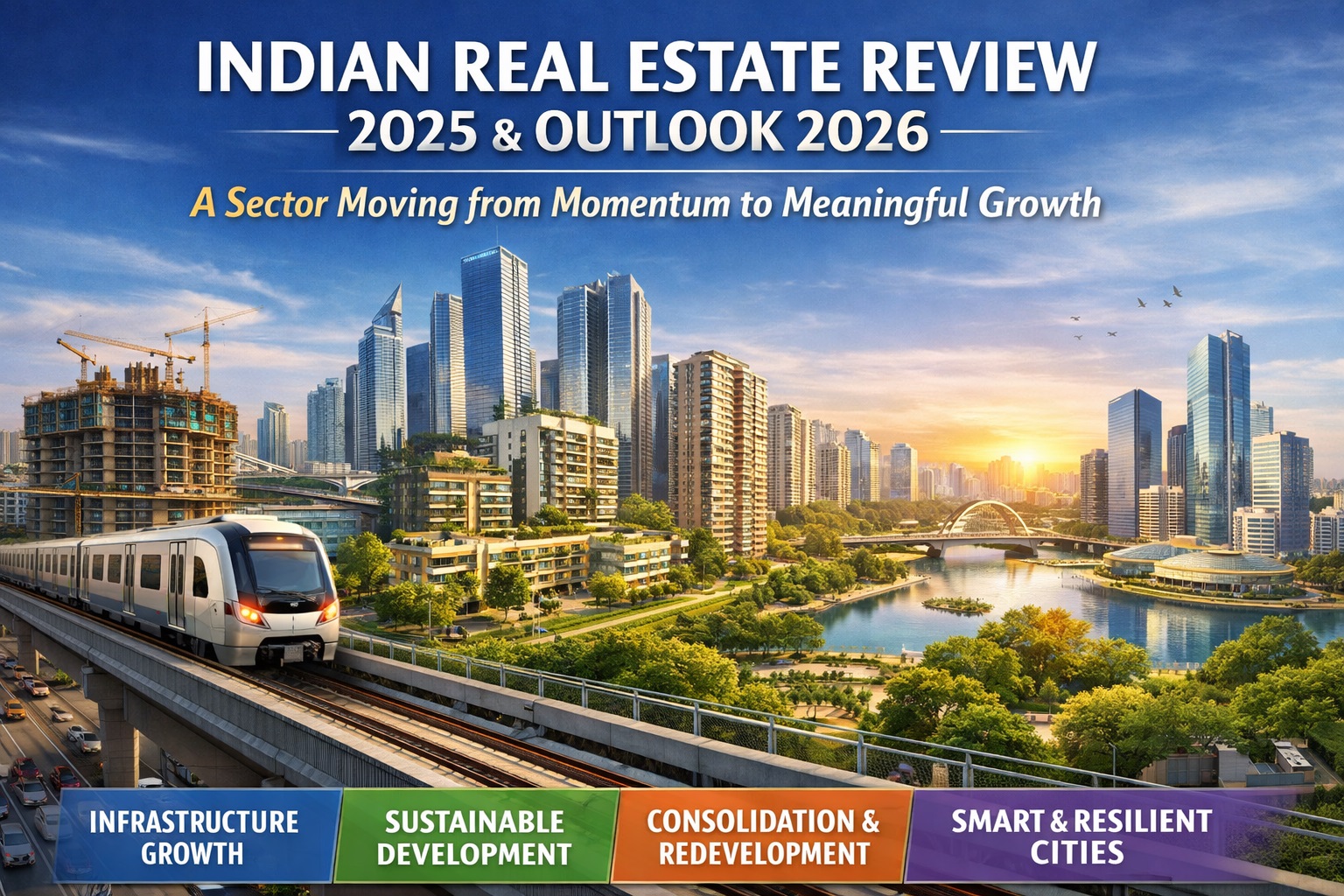
The Indian real estate sector concluded 2025 on a confident note, underpinned by consistent end-user demand, regulatory maturity and infrastructure-led transformation. Industry leaders indicated that the year represented a decisive move towards consolidation, experience-focused development and long-term value creation, providing a strong platform for growth in 2026. Advertisement


Reflecting on market performance, the President of NAREDCO Maharashtra stated that 2025 marked a landmark phase for the sector, characterised by policy reforms, demand across asset classes and a renewed focus on sustainable urbanisation. He noted that the industry demonstrated resilience while accelerating its shift towards greater transparency, technology adoption and consumer-centric practices.
Infrastructure emerged as the most significant growth driver, reshaping value creation across cities, particularly within the Mumbai Metropolitan Region. The Managing Director of Crest Ventures Limited observed that connectivity had evolved from being a supporting factor to the primary determinant of real estate value. He added that Mumbai was gradually transforming into a multi-nodal metropolitan region, with emerging well-connected nodes beginning to outperform traditional locations as travel times reduce.
This change was echoed by the Co-Founder and Managing Director of Srishti Group, who noted that homebuyers were increasingly prioritising accessibility over distance, evaluating locations based on ease of daily movement, time efficiency and access to workplaces, social infrastructure and lifestyle amenities.
Residential demand during the year remained firmly end-user driven, with consistent traction across mid-income, premium and luxury segments. Buyers showed a strong preference for reputed developers, well-planned projects and future-ready neighbourhoods. The Chairman of The Guardians Real Estate Advisory pointed out that luxury and ultra-luxury housing recorded strong absorption, driven by high-net-worth individuals and non-resident Indians seeking long-term stability in Indian real estate assets.
Redevelopment emerged as a defining theme, particularly in land-constrained urban markets. The Promoter of Ariha Group stated that redevelopment had become the most viable route for societies and tenants to access modern infrastructure and improved living standards amid rising land scarcity.
Beyond volumes and infrastructure, the sector witnessed a deeper shift in design philosophy. The Managing Director of Superb Realty explained that real estate was increasingly focused on creating intelligent, human-centric ecosystems, with design quality, technology integration and well-being becoming essential drivers of long-term relevance rather than optional differentiators.
Commercial real estate remained stable through the year, supported by Grade-A office demand, flexible workspaces and Global Capability Centres. Other segments, including warehousing, plotted developments and gated communities, also gained momentum. The Director of ORA Group highlighted strong year-on-year growth in plotted developments, driven by buyer preference for land ownership, flexibility and long-term appreciation.
From a capital and advisory perspective, the Founder of The Mandate House noted that 2025 represented a phase of consolidation, with developers focusing on faster execution, reduced leverage and stronger governance, making the sector more financially disciplined and aligned with long-term fundamentals.
Looking ahead to 2026, industry leaders expect growth to be more measured and infrastructure-aligned, with sustainability, redevelopment and integrated urban planning taking centre stage. Connectivity is expected to continue shaping demand patterns, while mixed-use, walkable developments and people-centric design are likely to define the next phase of urban evolution.
Source: NAREDCO Press Bureau

5th Jun, 2025

25th May, 2023

11th May, 2023

27th Apr, 2023
Advertisement





 Facebook
 Whatsapp
