Advertisement










Private equity has played a significant role in shaping Indi...
In today’s real estate landscape, fitness is often treated...
In this episode of Prop Personalities, we sit down with Hars...
Luxury real estate is one of the most talked-about segments ...
Welcome to Prop Personalities by Prop News Time - a podcast ...
Indian Railways is aiming to operationalise the indigenously developed automatic train protection system, Kavach, on the high-density Delhi-Mumbai and Delhi-Howrah corridors during 2026, after missing the revised deadline of December 2025. Officials indicated that steady progress and an accelerated implementation strategy are supporting the new target. Around 25 per cent of the work on these routes has already been commissioned and is ready for use, while key components have been installed across the remaining sections. Kavach is designed to automatically apply brakes if loco pilots fail to maintain prescribed speed limits, enhancing operational safety on busy rail corridors.
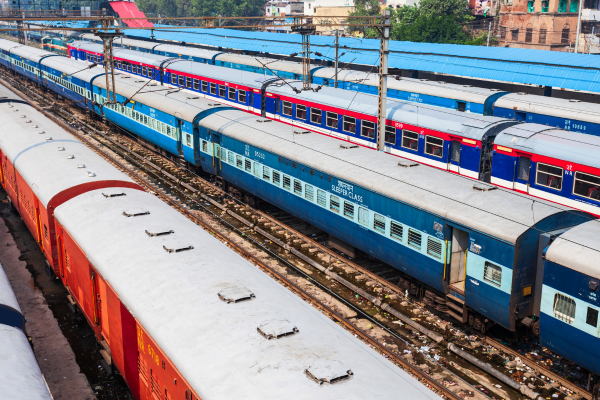
Indian Railways is now hopeful of operationalising the Kavach automatic train protection system on routes connecting Delhi with Mumbai and Howrah during 2026, following delays in meeting the earlier deadline of December 2025. Officials stated that efforts are being intensified to complete the remaining work on these high-density corridors. Advertisement


Kavach is an indigenously developed automatic train protection system that assists loco pilots in maintaining specified speed limits by automatically applying brakes when required. According to officials, about 25 per cent of the work on the Delhi-Mumbai and Delhi-Howrah routes has already been commissioned and is ready for use, while major components have been installed across the remaining 75 per cent of the network.
Railways had earlier indicated that Kavach installation on these routes would be completed by March 2025, a timeline that was later extended to December 2025. The revised schedule was outlined in budget documents for the revised estimates of 2024-25 and budget estimates for 2025-26.
An update on the progress of Kavach installation was shared in the Lok Sabha earlier this month, outlining that Kavach version 4.0 had been successfully commissioned on 738 route kilometres. This included the Palwal-Mathura-Nagda section on the Delhi-Mumbai corridor and the Howrah-Bardhaman section on the Delhi-Howrah corridor. Implementation work has also been taken up on the remaining sections of both corridors.
The update noted that optical fibre cable had been laid along 7,129 kilometres of track, alongside the installation of 800 telecom towers. Other components, including station Kavach, track-side equipment and loco Kavach, have been installed across hundreds of stations, thousands of route kilometres and more than 4,000 locomotives.
Experts highlighted that the growing volume of train operations has increased the need for technological support to minimise human error. Field trials of Kavach on passenger trains began in 2016, and the system was adopted as the national automatic train protection solution in 2020. Experience gained from earlier versions was used to roll out Kavach version 4.0 during the past year.
Railways has initiated track-side implementation across more than 15,500 route kilometres covering the Golden Quadrilateral, Golden Diagonal and other high-density network sections. Bids have also been invited to equip an additional 9,069 locomotives with Kavach version 4.0 as part of phased deployment.
Officials acknowledged that the limited number of approved equipment manufacturers had initially slowed progress. However, the number of companies authorised to install Kavach has increased to more than five, with expectations that approvals could rise significantly in 2026 to support faster implementation across the expanding rail network.
Source - PTI

5th Jun, 2025

25th May, 2023

11th May, 2023

27th Apr, 2023
Advertisement





 Facebook
 Whatsapp
