Advertisement








When should a housing society in Mumbai start considering re...
From GST on JDAs to SEBI’s REIT reclassification and the S...
Stay ahead in the world of real estate with our daily podcas...
Stay ahead in the world of real estate with our daily podcas...
In a strategic move to accelerate the Mumbai 3.0 vision, the Mumbai Metropolitan Region Development Authority (MMRDA) recently hosted a high-level Korean delegation on the sidelines of the India Global Forum. The meeting marked a continuation of last year's MoU between MMRDA and the World Smart Cities Forum (WSCF), enabling Mumbai's induction into the Global Twin Cities Platform. Discussions centred on adopting Korean smart city practices, attracting FDI, and launching joint pilot projects. Key areas included mobility solutions, innovation zones, transit-oriented development, and fintech hubs, with a clear focus on future-ready urban transformation.
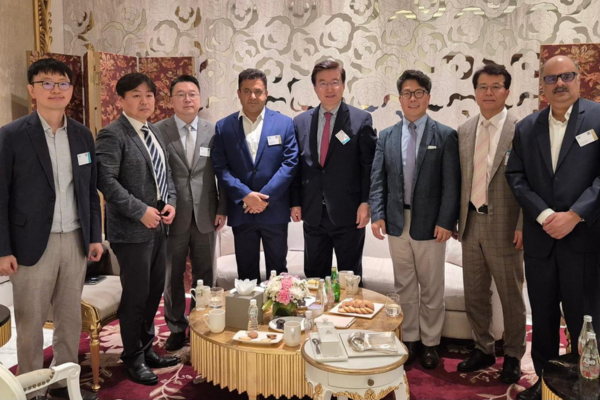
The Mumbai Metropolitan Region Development Authority (MMRDA) held high-level discussions with a visiting delegation from the Republic of Korea earlier this week, in a significant development aimed at shaping Mumbai's urban evolution under the Mumbai 3.0 vision. The exchange, held at the Jio World Centre during the India Global Forum, was spearheaded by Dr. Sanjay Mukherjee, IAS, Metropolitan Commissioner of MMRDA. Advertisement


The Korean team included senior representatives from government bodies, urban research institutes, academic circles, and global technology leaders such as the Incheon Free Economic Zone Authority (IFEZ), Korea Trade-Investment Promotion Agency (KOTRA), and the World Smart Cities Forum (WSCF). This collaborative effort follows the Memorandum of Understanding signed between MMRDA and WSCF at the World Economic Forum in Davos the previous year, under which Mumbai officially became a part of the Global Twin Cities Platform.
The core agenda revolved around cooperation in the development of smart infrastructure, adoption of global urban innovations, and strategies for investment mobilisation. Key names from the Korean side included Sang-ho Lee (Director, IFEZ), Byeong-il Woo (Director, KOTRA Mumbai), James Jung-Beck Kim (Policy Special Advisor, IFEZ), and Dr. Young-sup Joo (Distinguished Professor at Seoul National University and former Minister of SMEs and Startups in Korea). Jaewon Peter Chun, President of WSCF, and Grant Guk-hwan Cho, Vice Chairman of Kanavi Mobility and former Samsung executive, also participated.
The interaction highlighted the importance of replicating Incheon's transformation model, which helped evolve it into a USD 100 billion economy through smart infrastructure and integrated urban frameworks. MMRDA aims to utilise these learnings in planning transit hubs, innovation clusters, and smart governance mechanisms in Mumbai.
KOTRA's network and IFEZ's investor ecosystem were also discussed as channels to boost foreign direct investment (FDI) in areas like logistics parks, mobility corridors, and fintech zones. The delegation explored collaborative opportunities in pilot projects, sustainable townships, AI-based urban management systems, and mixed-use developments.
Particular attention was paid to transit-oriented development (TOD) zones, smart townships, and industrial corridors. High-priority sectors identified during the meeting included green mobility, smart housing clusters, data centres, and affordable housing developments. Through the WSCF's Twin Cities framework, MMRDA also intends to build capacity and benchmark its progress in line with global sustainability and innovation standards.
Dr. Sanjay Mukherjee stated that the partnership with IFEZ, KOTRA, and WSCF would grant Mumbai access to advanced expertise in high-tech infrastructure and investment models. He emphasised that the collaboration would stimulate inclusive growth, enhance employment prospects, and position the region competitively on the global stage.
The Incheon Free Economic Zone (IFEZ) represents South Korea's leading economic development project, focused on foreign investments and innovation-led growth in Songdo, Yeongjong, and Cheongna. Meanwhile, the WSCF, based in London, is known for promoting inclusive and tech-enabled urban development globally.
With this partnership gaining traction, MMRDA is looking to usher in a new era of smart urban planning, one that aligns with international benchmarks and delivers transformative outcomes for the Mumbai Metropolitan Region.

5th Jun, 2025

25th May, 2023

11th May, 2023

27th Apr, 2023
Advertisement








 Facebook
 Whatsapp
