Advertisement










Private equity has played a significant role in shaping Indi...
In today’s real estate landscape, fitness is often treated...
In this episode of Prop Personalities, we sit down with Hars...
Luxury real estate is one of the most talked-about segments ...
Welcome to Prop Personalities by Prop News Time - a podcast ...
The Nagpur Metro is a transformative public transit project managed by Maha-Metro, enhancing mobility in Nagpur, Maharashtra. Phase I features two lines: the Orange Line (19.65 km) connecting Automotive Square to Khapri and the Aqua Line (18.55 km) from Prajapati Nagar to Lokmanya Nagar, forming a 38.2 km network with 36 stations. Fully operational since December 2022, it has improved urban connectivity. Phase II, adding 43.8 km and 32 stations, aims to expand access to suburban and industrial areas at an estimated cost of INR 6,708 crore.
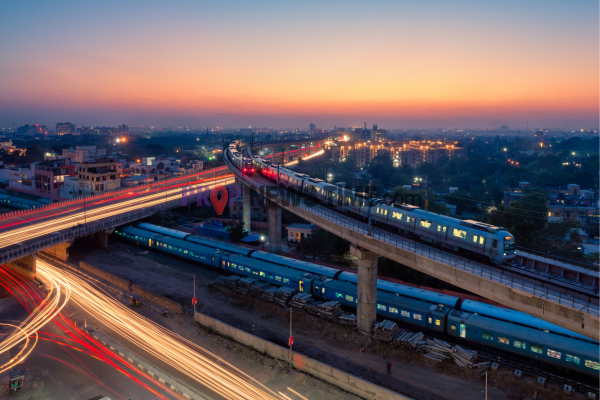
The Nagpur Metro stands as a significant leap in public transportation for Nagpur, Maharashtra. Nagpur is often referred to as the Orange City and is the geographical center of India. Managed by the Maharashtra Metro Rail Corporation Limited (Maha-Metro), a joint venture between the Government of India and the Government of Maharashtra, the metro system is designed to provide a reliable, efficient, and eco-friendly mode of transport for the city's growing population. Advertisement


Phase I of the Nagpur Metro consists of two corridors: Orange Line (North-South Corridor): This corridor spans 19.65 kilometres, connecting Automotive Square in the north to Khapri in the south. It features 18 stations, including key stops like Sitabuldi Interchange, Airport South, and Ajni Square. This line primarily serves important residential and commercial hubs, as well as Nagpur's industrial zones.
Aqua Line (East-West Corridor): Covering 18.55 kilometres, the Aqua Line stretches from Prajapati Nagar in the east to Lokmanya Nagar in the west, featuring 19 stations. It traverses through bustling localities like Kasturchand Park, Sitabuldi, and Hingna, ensuring that commuters can easily access educational institutions, markets, and business districts.
Together, these two lines form a 38.2-kilometre network with 36 stations and 2 depots (at Mihan and Hingna). The entire network was made fully operational by December 2022, significantly improving transit options for the city's population.
Phase II of the Nagpur Metro is set to extend the existing network by an additional 43.8 kilometres, incorporating 32 new stations. Key extensions include: Orange Line Extension: From Khapri to Butibori MIDC ESR (18.5 kilometres) and from Automotive Square to Kanhan River (13 kilometres). Aqua Line Extension: From Lokmanya Nagar to Hingna (6.6 kilometres) and from Prajapati Nagar to Transport Nagar (5.5 kilometres).
These extensions aim to improve connectivity to industrial areas and suburban regions, further enhancing the metro's utility. The estimated cost for Phase II is INR 6,708 crore, with funding from the Government of India, Government of Maharashtra, and international agencies like the Asian Development Bank (ADB).
The total cost of Phase I of the Nagpur Metro was initially estimated at INR 8,650 crore but reached INR 9,279 crore due to additional construction and operational requirements. For Phase II, the projected cost is INR 6,708 crore, reflecting the scale of expansion and the need for advanced infrastructure. The financial model for the project includes contributions from central and state governments, as well as loans from international lenders such as the KfW Development Bank and the ADB.
Since its launch, the Nagpur Metro has seen varying levels of ridership. On October 12, 2024, during the Dussehra festival, the metro recorded its highest single-day ridership of 1.44 lakh passengers. However, ridership has faced challenges, including a significant drop due to fare hikes. Daily commuters decreased from 1.3 lakh to 65,000, resulting in monthly operating losses of INR 25 to INR 30 million. Addressing these challenges through affordable fare structures and improved last-mile connectivity remains crucial for increasing passenger numbers.
The Nagpur Metro has spurred real estate development and commercial growth around metro stations. Areas like Sitabuldi, Lokmanya Nagar, and Khapri have seen rising property values and increased business activity. The metro has also improved access to educational institutions, hospitals, and industrial hubs, facilitating easier commutes for students, professionals, and workers.
As Phase II of the Nagpur Metro progresses, the city's transportation network is set to become even more comprehensive. The extensions will provide better connectivity to suburban and industrial areas, enhancing economic opportunities and quality of life. The success of the Nagpur Metro serves as a model for other Tier-II cities in India, showcasing how smart urban planning and sustainable practices can transform public transportation

5th Jun, 2025

25th May, 2023

11th May, 2023

27th Apr, 2023
Advertisement





 Facebook
 Whatsapp
