Advertisement










Private equity has played a significant role in shaping Indi...
In today’s real estate landscape, fitness is often treated...
In this episode of Prop Personalities, we sit down with Hars...
Luxury real estate is one of the most talked-about segments ...
Welcome to Prop Personalities by Prop News Time - a podcast ...
Gurugram's public transport is set for a major boost with a 28.8 km metro line connecting Millennium City Centre to Cyber City. The INR 5,452 crore project, approved in June 2023, includes 27 stations and aims to ease traffic congestion while promoting eco-friendly commutes. Systra India, the design consultant, is finalising route alignment and station details, with surveys integrating GPS technology and a 500-metre buffer zone. The metro expansion marks the first in seven years and aligns with Gurugram's growing urban demands. Expected to improve mobility, reduce pollution, and support economic growth, the project underscores a shift toward sustainable urban infrastructure.
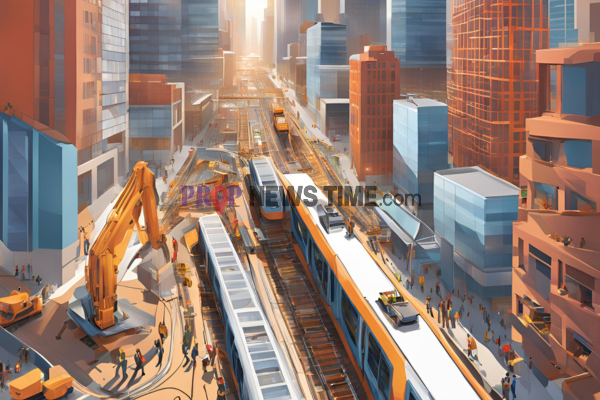
Gurugram is setting up for a significant upgrade in its public transport system with the upcoming metro line connecting Millennium City Centre to Cyber City. This project aims to improve mobility in a city that has seen rapid growth in population and commercial activity but has lagged in public transportation infrastructure. Advertisement


The Gurugram Metro Rail Limited (GMRL) has announced that Systra India, the detailed design consultant for the project, will soon finalise the route alignment and determine the locations of all 27 stations along the 28.8 km corridor. The survey is expected to take two to three months and will utilise GPS technology to accurately map the stations and their infrastructure, including entry and exit points. Additionally, a 500-metre buffer zone around the metro route will be surveyed to ensure smooth connections to other transport modes, facilitating easier transfers for commuters.
This survey is particularly important as it has been five years since the last assessment, during which the city has undergone numerous changes. GMRL Managing Director Chandra Shekhar Khare has reached out to local authorities, including the Gurugram Metropolitan Development Authority (GMDA) and traffic police, seeking their cooperation in this crucial phase of the project. The integration of the new metro line with existing infrastructure is essential to avoid disruptions and ensure that it meets the needs of the growing population.
The new metro line is part of a broader effort to enhance public transportation in Gurugram, which has been slow to develop despite the city's booming economy. Currently, Gurugram has only 17 km of metro lines, consisting of the Delhi Metro's yellow line and the Rapid Metro. The last major expansion in the metro network occurred in 2017 with the completion of the Rapid Metro, which serves key areas like Cyber City and Golf Course Road.
The Union Cabinet approved the Millennium City-Cyber City metro line in June 2023, and Prime Minister Narendra Modi laid the foundation stone in February 2024. With a budget of INR 5,452 crore, this project marks the first metro extension in Gurugram in seven years. As the city continues to grow as a hub for IT firms and corporate offices, the new metro line is expected to significantly ease traffic congestion and provide reliable transportation for residents and commuters alike.
In addition to improving daily commutes, the new metro line will also contribute to the city's environmental goals by promoting public transport over private vehicle use. This shift is crucial for reducing traffic congestion and lowering pollution levels, which have become pressing issues in urban areas like Gurugram. As the project progresses, stakeholders are hopeful that it will pave the way for further expansions in the metro network, ultimately transforming Gurugram into a more accessible and sustainable city.
As the survey and planning stages commence, residents and businesses are eagerly anticipating the benefits this new metro line will bring, not just in terms of transportation but also in enhancing the overall quality of life in Gurugram.

5th Jun, 2025

25th May, 2023

11th May, 2023

27th Apr, 2023
Advertisement





 Facebook
 Whatsapp
